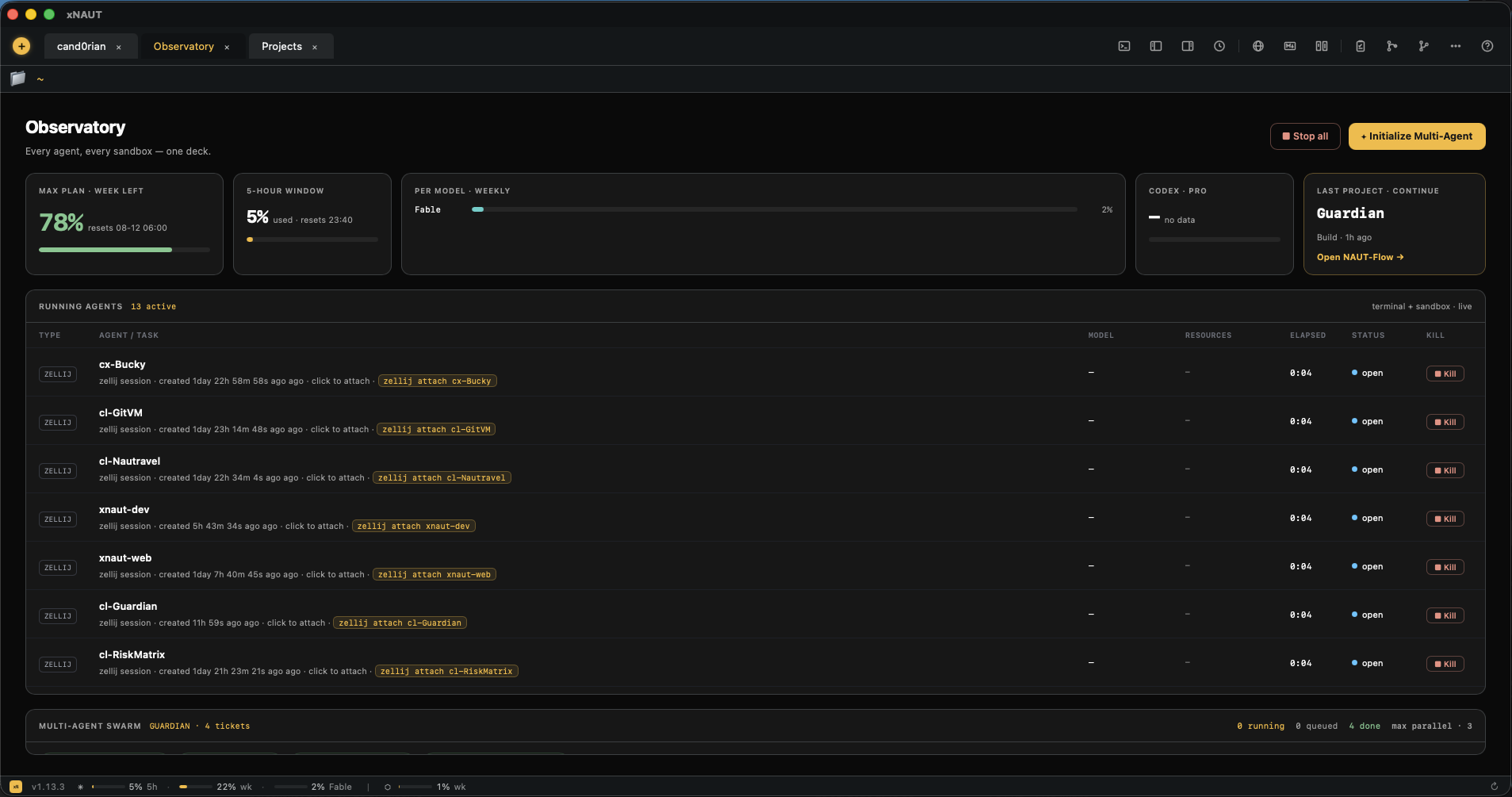
xNAUT is a native, 20 MB terminal that runs your AI coding agents, tracks their status live, and proves every hour of work — without sending a byte to the cloud.
Free & open source · MIT · latest release · Apple Silicon, Intel & Windows x64
01 — FEATURES
Every feature exists because running Claude Code, Codex, and friends in a plain terminal means losing track of who is doing what, where.
Launch claude, codex, gemini or any CLI agent from a user-editable registry. Live status pills — working, done, blocked — with real-time hook pushes. Click a pill, jump to its tab.
One modal to spin up isolated worktrees with a recipe where push and status both just behave — then drop any agent straight into the new tree.
Side-by-side diffs where agents leave inline annotations — summary, rationale, confidence — anchored to the exact hunk. Notes update live as agents write them.
Each project is a workspace with its own tabs, terminals and zellij session. Switch projects, get your exact context back — nothing bleeds between them.
Split any pane with a sandboxed browser, a markdown editor with Mermaid, a file tree or a code editor. Docs and previews live beside the shell, not in another app.
Twelve built-in themes with full ANSI palettes — Catppuccin, Tokyo Night, Nord, Dracula — plus a generator: describe a vibe, get a matching theme for the whole app.
Draw agent workflows as nodes — triggers, agents, approval gates, bounded retries — with versioning, validation, cost limits and model governance. Or just describe it: the LoopBuilder agent drafts the loop and repairs validator feedback itself.
An Obsidian-style vault inside the terminal — wikilinks, backlinks, tags, search and templates for work and personal notes. The Vault Librarian agent searches, files and writes notes on request.
Your vault's wikilinks and your codebase's imports, rendered as a force-directed orb — 2D or a slow-rotating 3D nebula. Switch between notes and code with one selector, all scanned locally in Rust.
A built-in MCP server on localhost turns the terminal into a tool your agents call. Claude Code, Codex or any MCP client can list projects, create and update tickets with conflict-safe revisions, and read or write project docs in the vault. Per-session bearer token, copy-ready connection object in Project Settings.
{
"xnaut": {
"type": "http",
"url": "http://127.0.0.1:<port>/mcp",
"headers": { "Authorization": "Bearer <session-token>" }
}
}
// tools: projects · tickets · vault docs — all local
02 — PROOF OF WORK
The Work Session Logger records every command with timestamps and duration, chains them into a SHA-256 Merkle tree, and exports a client-ready HTML report. A QR code on the report lets anyone verify the session wasn't edited after the fact.
03 — LOCAL-FIRST AI
Explain Screen, AI chat and theme generation run against Ollama or LM Studio on localhost by default. Cloud providers are there when you want them — behind a privacy monitor that flags leaked keys and PII before a prompt leaves the app.
04 — HOW IT STACKS UP
Everyone's open source now. Nobody else fits a terminal, an agent fleet, and a notary into 20 MB.
| xNAUT | Warp | Cursor | Orca | Ghostty | |
|---|---|---|---|---|---|
| Price | Free · MIT | $20/mo credits | $20/mo | Free · MIT | Free · MIT |
| Ships as | 20 MB native app | app + cloud | VS Code fork | Electron app | native binary |
| Full power, no account | ✓ | AI needs account | — | ✓ | ✓ |
| AI fully on localhost | ✓ Ollama · LM Studio | cloud credits | cloud models | via your agent | no AI |
| Any CLI agent, live status | ✓ | its own agents | its own agents | ✓ | — |
| Visual agent-loop designer | ✓ nodes + gates | cloud (Oz) | — | — | — |
| MCP server for agents | ✓ docs · tickets | — | client only | CLI, not MCP | — |
| Signed proof of billable work | ✓ Merkle + QR | — | — | — | — |
| Prompt privacy guard | ✓ keys · PII | — | — | — | — |
Ghostty is a great terminal. Warp is a great subscription. Cursor is a great IDE. Orca is a great orchestrator.
xNAUT is the whole bridge crew — in 20 MB, for free.
Snapshot July 2026. Warp: AGPL client, $20/mo Build plan for AI credits. Cursor: proprietary, $20/mo Pro; 3.x runs parallel/cloud agents — its own, not yours. Orca: MIT, BYO agent subscriptions. Ghostty: MIT, no AI by design.
05 — FAQ
Everything you need to know about xNAUT, your agents, and the ∅ funding model.
A native terminal for developers who work with AI coding agents. One 20 MB app holds your terminals, your agents with live status, git worktrees, diffs with AI annotations, project docs and a tamper-evident work log — instead of four separate tools.
MIT-licensed, no paid tier, no account, no trial that expires. The catch is there is no catch — we're backed by ∅ Nobody, so there's no investor to monetize you for. If you use cloud AI providers, you pay them directly; local models cost nothing.
Only what you point somewhere: prompts go to the AI provider you configure (localhost Ollama/LM Studio by default), and the app checks GitHub Releases for updates. The app has no telemetry and no analytics — there is no backend of ours to send anything to. (This website uses self-hosted, cookieless privacy-respecting analytics; the app sends nothing.) The privacy monitor even flags API keys and PII before a prompt leaves the app.
Any CLI agent. Claude Code, Codex, Gemini, Grok, OpenCode come preconfigured; anything else drops into the registry at ~/.config/xnaut/agents.toml. Live status pills work for all of them.
No. Explain Screen, chat and theme generation run against Ollama or LM Studio on localhost out of the box. Cloud providers (Anthropic, OpenAI, OpenRouter, Perplexity) are optional and use your own keys, stored locally.
Rust + Tauri v2. The UI renders in your OS's built-in webview instead of shipping a bundled Chromium, so the whole app is a ~20 MB download where Electron apps ship hundreds of megabytes.
Every command is recorded with timestamp and duration and chained into a SHA-256 Merkle tree. The exported report (HTML with a QR verification code) proves the session wasn't edited after the fact — hours you can hand to a client. It proves integrity of the record, not the quality of the work.
For the terminal side of Warp: yes — without the account, the credits or the cloud. For Cursor: xNAUT isn't an IDE; it's where your CLI agents live and work. Many people run both: Cursor for editing, xNAUT for running the agent fleet. See the comparison above for specifics.
Orca is an excellent open-source agent orchestrator built on Electron and VS Code's editor. xNAUT covers the same agent + worktree workflow in a native 20 MB app, and adds what Orca doesn't have: local-first AI features, a doc vault, visual agent loops, and cryptographically signed work sessions.
macOS (Apple Silicon + Intel) is the primary platform. Windows x64 installers (.msi / .exe) ship with every release — treat them as early: the core terminal works, but workspace features that rely on zellij are macOS-first. No Linux builds yet.
Yes — that's the MCP server. Any MCP client can list projects, create and update tickets (revision-safe), and read or write project docs in the vault, all over localhost with a per-session token.
Fast — the release history speaks for itself: ten releases across v1.8 alone, from the diff viewer to the knowledge graph. Auto-update checks GitHub on startup, so you're one click behind at most. The changelog is public.
$ brew install --cask 48nauts-operator/tap/xnaut